

In today’s hyperconnected world, pay-per-click advertising (PPC) fuels the digital economy—driving traffic, boosting sales, and keeping online content free for billions of users. Yet behind every click lies an overlooked environmental cost. From the energy-hungry data centers powering Google Ads, Meta Ads, and Microsoft Advertising to the consumption habits these ads encourage, PPC campaigns quietly contribute to carbon emissions, resource depletion, and climate change. Understanding how digital advertising shapes our environment—and how it can be reshaped to support sustainability—is now critical for brands, nonprofits, and environmental organizations alike.
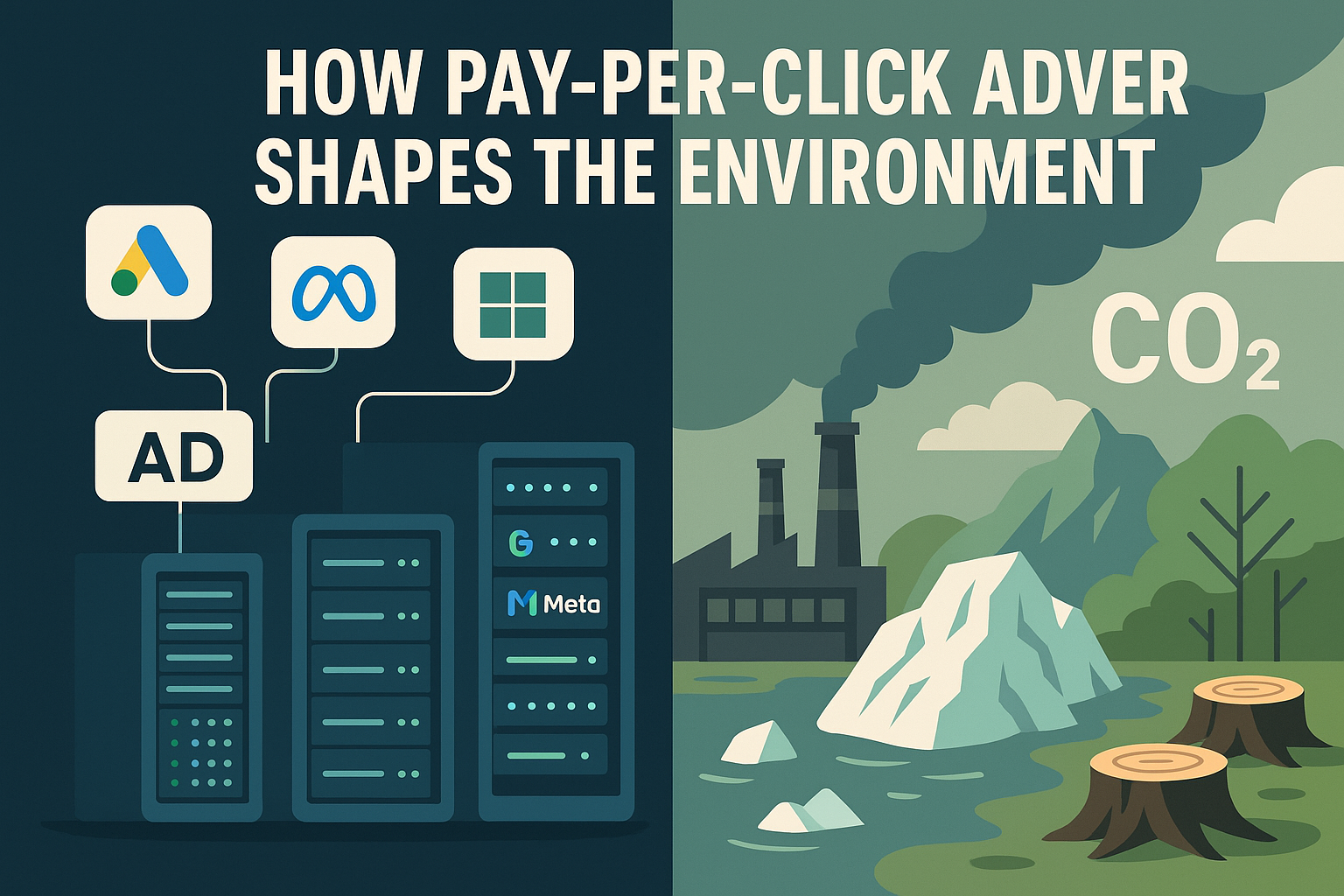
The Overlooked Environmental Impact of Digital Advertising
pay-per-click advertising (PPC) powers the modern internet. It drives traffic, fuels online businesses, and keeps content free for billions of users. Yet while the financial costs of PPC are well known, its environmental costs often go unnoticed.
Behind every impression and click are vast data centers, complex real-time bidding networks, and endless streams of digital content—all consuming energy and producing emissions. On top of this, PPC campaigns influence behavior by driving consumption, which indirectly increases resource extraction, pollution, and waste.
Understanding this double-edged impact is essential for organizations that want to embrace digital marketing without undermining their environmental values.
The Carbon Footprint of Paid Search Ads
PPC campaigns depend on infrastructure that requires enormous energy:
- Data centers: Ad platforms like Google Ads, Microsoft Advertising, and Meta Ads run global networks of energy-intensive data centers.
- Programmatic bidding systems: Real-time bidding for ad space happens in milliseconds, consuming power across multiple servers simultaneously.
- Content delivery networks (CDNs): Delivering ad creatives—especially video—requires energy-intensive distribution worldwide.
According to the Cambridge Institute for Sustainability Leadership, the advertising industry produces 5–6% of global CO₂ emissions, putting it on par with aviation. That means every click has a carbon cost.
Video ads have the heaviest footprint, especially through YouTube Ads and Meta Ads on Facebook and Instagram, because they require higher bandwidth and data storage.
How PPC Campaigns Drive Consumption and Waste
Search engine marketing (SEM) isn’t just a channel; it’s a powerful behavioral influence. By increasing demand, PPC campaigns indirectly drive:
- Higher production volumes, which increase energy use and emissions
- More packaging waste, especially from e-commerce and fast-moving consumer goods
- Overexploitation of natural resources, from water to rare minerals
Greenpeace has warned that ad-driven consumerism accelerates climate change by promoting high-carbon sectors such as:
- Fast fashion
- Automotive and air travel
- Industrial agriculture
In short, PPC ads can magnify the environmental footprint of the industries they promote, even when the ads themselves are digital.
Why PPC Supports Environmental Change
Despite these challenges, PPC can be a powerful force for good. When used to promote sustainability, PPC campaigns can raise awareness, influence behavior, and fund conservation efforts.
Real-World Examples of Green PPC in Action
- World Wildlife Fund (WWF)
Runs targeted Meta Ads to educate audiences on deforestation in the Amazon rainforest and raise funds to protect endangered species. - United Nations Environment Programme (UNEP)
Uses YouTube Ads to promote global sustainable development goals, reaching millions with educational campaigns about recycling and emissions reduction. - Greenpeace
Leverages Google Ads to fund marine conservation campaigns in the Great Barrier Reef and protect old-growth forests in the Congo Basin.
These campaigns show how paid search advertising can amplify sustainability efforts by delivering timely, targeted messages at scale.
How Healthcare Paid Search Advertising Supports a Greener Online Environment
The healthcare sector shows how paid search advertising can be both impactful and resource-intensive. Hospitals and clinics use targeted campaigns to promote preventative care, book patient appointments, and share essential health information. While medical PPC campaigns deliver helpful information to high-intent audiences, they also rely on energy-intensive ad infrastructure that adds to the industry’s digital carbon footprint.
Many healthcare organizations partner with a medical PPC agency that offers healthcare google ad campaigns focused on efficiency and relevance. The medical PPC agency refines keyword strategies, applies precise geo-targeting, and reduces redundant impressions. These medical paid search services cut unnecessary impressions and lower data center load. Fewer wasted impressions also mean less wasted ad spend and fewer emissions. By lowering the energy required to reach each user, targeted medical PPC campaigns show how precise paid search strategy can directly improve environmental outcomes.
When healthcare organizations use paid search ads more strategically, they reach the right patients with fewer resources. This model gives a clear blueprint for environmental nonprofits, which can use similar data-driven methods to make their campaigns more effective while reducing their own environmental impact.
The Hidden Lifecycle of a Digital Ad
To understand the environmental cost of PPC, consider the full lifecycle of a typical campaign:
- Creative Production
Designers, writers, and videographers create ads—often using energy-intensive tools and rendering systems. - Data Hosting & Delivery
Creatives are stored on servers and delivered through global CDNs, requiring continuous electricity. - Ad Delivery & Bidding
Real-time auctions on Google Ads and Microsoft Advertising involve hundreds of automated server calls per second. - User Engagement & Tracking
Each impression, click, and conversion is logged, processed, and stored, consuming energy for analytics. - Post-Campaign Reporting
Teams analyze performance through platforms like Google Analytics, requiring yet more data processing.
Each step draws power, emits carbon, and contributes to the industry’s footprint.

Explore: Which Land Biome Has the Greatest Biodiversity?
Strategies to Make PPC Campaigns More Eco-Friendly
Environmental organizations can significantly reduce the footprint of their PPC campaigns by embracing eco-conscious practices:
Choose Renewable-Powered Platforms
Work with ad platforms that operate data centers powered by renewable energy. Google, for example, has pledged to run all data centers on carbon-free energy by 2030.
Use Smart Targeting to Cut Waste
Refine audience segmentation to minimize impressions shown to irrelevant users—this reduces both ad spend and energy use.
Repurpose and Compress Creatives
Reuse ad visuals and videos across campaigns, and optimize file sizes to lower delivery energy costs.
Limit High-Energy Formats
Use image-based or text ads when possible. Reserve energy-heavy video campaigns for high-priority launches.
Track Efficiency, Not Just Conversions
Use Google Analytics to measure engagement and pause underperforming ads that drain resources without delivering impact.
Why Environmental Campaigns Need PPC Experts
Running sustainable PPC campaigns requires technical expertise that many NGOs and nonprofits don’t have in-house. That’s why many partner with digital marketing agencies.
Specialized marketing agencies build high-performance PPC campaigns for mission-driven organizations—helping them reach eco-conscious audiences, reduce wasted impressions, and maximize impact while minimizing digital emissions.
By combining advanced targeting with sustainability best practices, skilled agencies can make PPC campaigns both effective and environmentally responsible.
The Future of Advertising and Environmental Responsibility
The advertising industry is beginning to confront its climate impact, and several major shifts are underway:
- 📊 Emission Tracking Standards: New frameworks are emerging to measure and report the carbon footprint of ad campaigns.
- ⚡ Emission-Smart Advertising: Agencies are shortening supply chains, reducing data waste, and adopting greener production practices.
- 🌍 Green Marketing Guidelines: Industry bodies are publishing rules to prevent greenwashing and encourage authentic sustainability messaging.
- 💚 Consumer Pressure: Public demand for sustainable brands is forcing advertisers to adopt sustainable development principles.
As these trends grow, pay-per-click advertising could become a key tool for driving climate-positive behavior—rather than just consumerism.

Looking ahead, privacy-safe video will also play a role in responsible media buying. HIPAA compliant healthcare YouTube ads will also be enviromentally responsible, so well-targeted video campaigns can deliver strong performance and be sustainable with the environment.
As these trends grow, pay-per-click advertising could become a key tool for driving climate-positive behavior—rather than just consumerism.
Key Takeaways
- PPC campaigns consume energy through every stage—creation, delivery, and analytics
- They can indirectly harm the planet by boosting consumption and resource extraction
- But when designed responsibly, PPC can fund and amplify environmental campaigns
- Choosing renewable-powered platforms, optimizing creatives, and reducing waste are critical
- Expert digital marketing agencies can help environmental organizations run eco-conscious PPC campaigns at scale
The Hidden Impact of Digital Ads
Pay-per-click advertising has a real, measurable environmental footprint—but it also holds incredible potential as a force for environmental good. By reducing waste, choosing clean-powered platforms, and focusing on campaigns that promote biodiversity conservation and fight climate change, organizations can align their marketing with their mission.
If the ad industry embraces emission-smart practices, PPC campaigns can evolve from part of the problem to part of the solution—funding positive change, shaping public attitudes, and helping build a more sustainable future.
Go To EuroBioDiversa